01 — Problem & Research
The bill arrives. The fun stops.
Group dining is a universal experience — but the moment the check hits the table, a relaxing evening turns into an awkward math problem. Who ordered what? Did we account for tax? Who's going to Venmo whom?
We validated this problem by interviewing 15 individuals with diverse dining frequencies. Their feedback directly shaped Chip's feature priorities.
"Some people don't send the exact amount, they'll just, like, round down, round up,"
Users wanted accuracy but couldn't justify the effort, leading to people overpaying or underpaying silently.
"It kind of gets awkward if you\’re the one managing it."
Organizers were forced to use external channels to chase payments, adding friction long after the meal ended.
02 — Solution & User Flow
Scan. Assign. Split. Done.
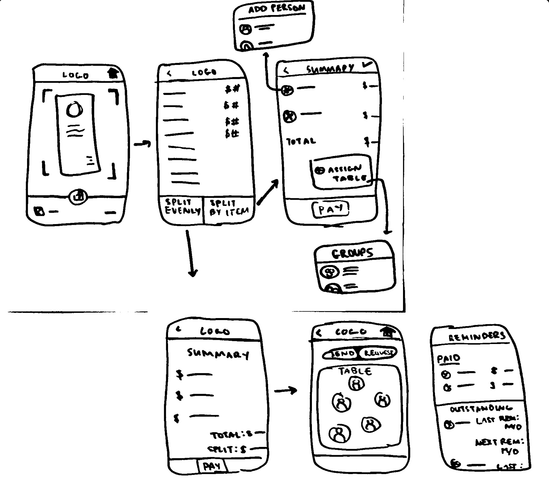
Chip handles the full lifecycle of a group payment in four steps — from receipt to repayment — without ever leaving the app.
01
Scan
In-app camera captures the receipt. Chip's algorithm itemizes prices including tip and tax.
02
Assign
Split evenly or by item. The organizer assigns each item to the right person — including shared items.
03
Calculate
Chip automatically calculates each person's exact share with accurate tax and tip allocation.
04
Pay
Friends transfer their share directly in-app. Organizer tracks outstanding payments.
05
Remind
Automated reminders follow up on unpaid balances — no awkward texts required.
★
Premium
Custom UI, detailed expense reports, and instant bank transfers via subscription.
03 — Competitive Analysis
Where competitors fall short.
We analyzed Forkit, Split Pay, and Tab to identify the gaps Chip could own — primarily around receipt accuracy, UX clarity, and post-split flow.
| Competitor | Key Gap | Chip's Advantage |
|---|---|---|
| Forkit | Algorithm inaccuracies; can't assign one item to multiple people | Superior receipt processing with accurate shared-item splitting |
| Split Pay | No loading indicator; unclear post-split flow | Streamlined UI/UX with a clear, guided flow from scan to repayment |
| Tab | Doesn't recognize many receipt formats; outdated home screen UI | Guaranteed accuracy across receipt formats with a modern interface |
04 — Business Model
Three revenue streams, one platform.
Chip's monetization model leverages user convenience and restaurant partnerships — keeping the core experience free while capturing value at the moments users need speed or restaurants want visibility.
Premium Subscriptions
$83,940
5% adoption at $4.99/mo or $49.99/yr per 10K users
Instant Transfer Fees
$5,400
1.5% fee, 3% of users monthly per 10K users
Restaurant Partnerships
$60,000
50 restaurants at $100/mo per 10K users
05 — Roadmap & Next Steps
What we'd build next.
Through development and testing we identified three priority pain points to address in the next iteration.
Users track who has paid or who still owes money manually
Organizers are responsible for marking whether a user has paid or not, recreating the friction Chip is meant to eliminate
Real-time payment tracker that automatically updates upon payment, possibly integrating with payment platforms like Venmo or Cash App.
Complicated flow for reassigning disputed items
Arguments over shared items mid-split create drop-off and frustration
Simplified dispute resolution flow with easy mid-split item reassignment
App may not send payment reminder notifications reliably
Users miss reminders, undermining the core accountability feature
Investigate and improve notification API integration for reliable delivery
My Contributions
What I owned on this project.
Owned the core split flow and notifications — the primary user-facing feature of the app
Led 15 user discovery interviews that directly shaped feature prioritization and roadmap
Managed scope, task tracking in Jira, and cross-team communication throughout the project
Researched competitors, market sizing, and user fit to inform the business model